A dissertation proposal sets the base for a strong research project. It tells your supervisor what topic you want to study, why it matters, how you plan to study it, and what academic value your work may add.
Many UK students first look at dissertation proposal examples and templates because a blank page slows the whole process. A clear sample helps you see how the title, aims, objectives, research questions, literature review, method, ethics, and timeline fit together.
Still, examples only help when you use them with care. A proposal must match your course, subject, university brief, and research plan. Copying a sample weakens academic integrity and may lead to rejection.
Dissertationist has created this guide to help UK students understand proposal structure, read samples in the right way, and use templates without losing their own research voice.
- What a Dissertation Proposal Means in UK Universities
- Dissertation Proposal Examples and Templates With UK Academic Context
- What Should a Dissertation Proposal Include
- Dissertation Proposal Template UK Students Can Adapt
- How to Write a Dissertation Proposal Step by Step
- Dissertation Proposal Format for UK Universities
- How to Read Dissertation Proposal Samples Correctly
- Common Proposal Mistakes That Delay Approval
- How Dissertationist Helps Students Plan a Clear Proposal
- Final Proposal Check Before Submission
What a Dissertation Proposal Means in UK Universities
A dissertation proposal is a short academic plan for your final research project. It shows the topic, research problem, aims, methods, key sources, ethics, and time plan before the full dissertation begins.
In UK universities, the proposal often works as an early check. Your supervisor reviews it to see whether the project has a clear scope, enough academic value, and a method that fits the research question.
A strong proposal does not need to solve the whole problem. It needs to show that the project makes sense and that you can complete it within the time, word count, and course rules.
UK university guidance often shows that proposal rules vary by school, degree level, and subject. Some departments give a fixed template, while others expect students to follow a broader academic structure.
How a Proposal Differs From the Final Dissertation
A proposal explains what you plan to do. A dissertation shows what you did, what you found, and what those findings mean.
The proposal looks forward. It sets the title, aim, questions, method, and source plan. It may include early ideas from the literature, but it does not include final results or a full discussion.
The dissertation comes later. It includes the full literature review, method, data analysis, findings, discussion, conclusion, and references.
Think of the proposal as a map. It helps your supervisor see the route before you start the full journey.
Why Supervisors Review the Proposal Before Research Starts
Supervisors review proposals to protect both the student and the academic standard of the course.
They check whether the topic has enough focus. A broad idea, such as “social media and business”, needs a sharper angle. A better version may focus on how UK fashion brands use TikTok to shape buying intent among Gen Z consumers.
They also check whether the method fits the research question. A question about student experience may need interviews. A question about market trends may need secondary data or survey results.
Ethics also matters. Any project that involves people, private data, health topics, workplace access, or sensitive views needs careful planning before data collection begins.
Dissertation Proposal Examples and Templates With UK Academic Context
Dissertation proposal examples and templates help students understand how academic planning looks before the full dissertation starts. A good example shows how each section links to the next. The title leads to the aim. The aim leads to the objectives. The objectives lead to the research questions. The questions shape the method.
A template gives order. It helps you place each section in a logical flow. However, the template should not control your thinking. Your topic, subject, data access, and university rules must guide the final proposal.
The dissertationist advises students to treat examples as learning tools. Read them to understand structure, depth, and tone. Then build your own proposal around your research problem.
A strong proposal should feel specific. It should not sound like a general essay plan. It should show your topic, your sources, your method, your limits, and your reason for choosing the study.
What Should a Dissertation Proposal Include
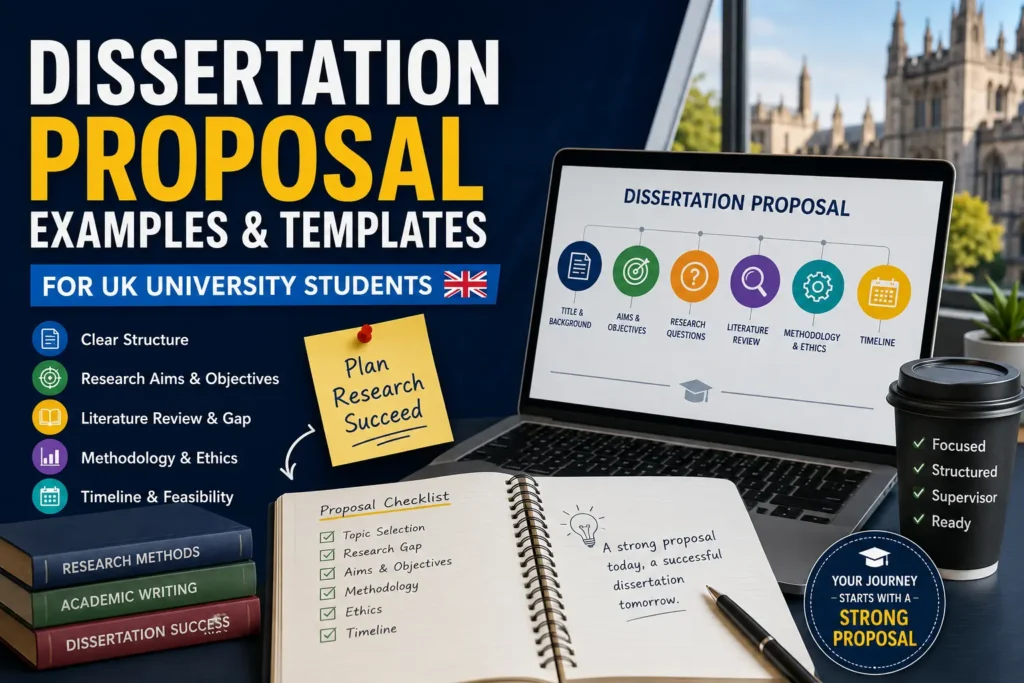
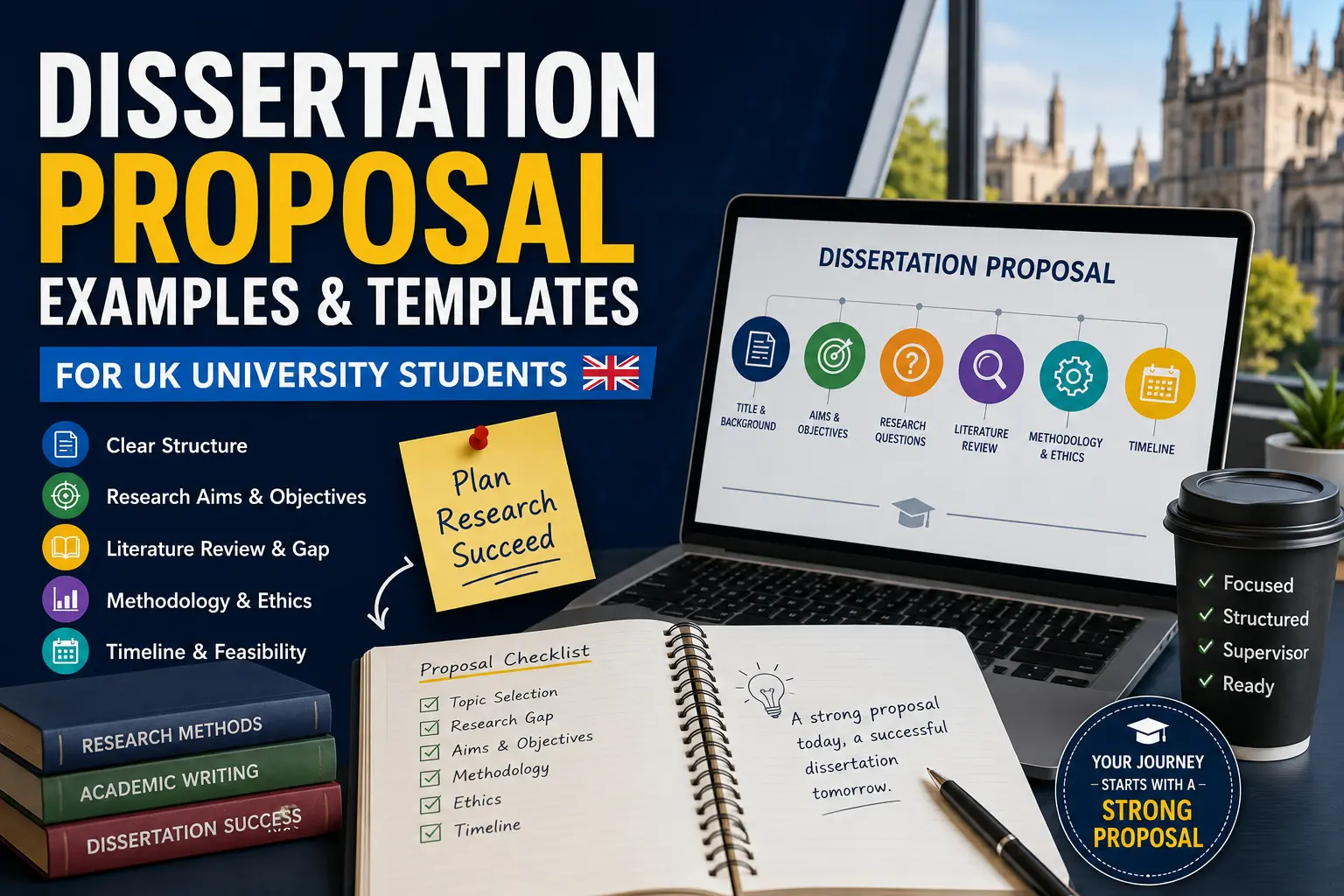
A dissertation proposal usually includes a working title, background, research aim, objectives, research questions, literature review, methodology, ethical considerations, timeline, and references.
Some UK courses may ask for extra sections, such as research significance, theoretical framework, conceptual framework, or expected contribution. PhD proposals often need deeper detail than undergraduate proposals.
The sections below explain the main parts most students need.
Working Title and Topic Focus
The working title gives the first sign of your research direction. It does not need to stay the same forever, but it should show the topic, field, and focus.
A weak title sounds too broad:
“The Impact of Social Media on Business”
A stronger title gives more shape:
“The Role of TikTok Marketing in Shaping Brand Engagement Among UK Fashion Consumers”
The second title tells the reader the platform, subject area, outcome, and group. It also points toward possible data collection and analysis.
A good working title often includes:
- The main topic
- The group or setting
- The research angle
- The subject area
- A clear limit
Dissertationist often help students narrow titles before they write the proposal because a weak title can weaken every section that follows.
Research Aim and Objectives
The research aim states the main purpose of the study. It answers one simple question: what does the project seek to find out?
A clear aim may look like this:
“To examine how TikTok marketing shapes brand engagement among UK fashion consumers aged 18 to 25.”
Objectives break the aim into smaller tasks. They show the steps needed to answer the main aim.
For example:
- To review existing literature on TikTok marketing and brand engagement
- To identify the main content features that influence consumer response
- To examine how UK fashion consumers engage with brand content on TikTok
- To assess how TikTok activity supports brand awareness and purchase interest
Each objective should link to the aim. Avoid adding objectives that do not lead back to the main study.
Research Questions That Guide the Study
Research questions turn the aim into questions that your dissertation can answer. They also shape the method.
For example:
- How does TikTok marketing influence brand engagement among UK fashion consumers?
- What content features encourage young consumers to interact with fashion brands?
- How do consumers describe the link between TikTok content and purchase interest?
Good research questions use clear words. They avoid vague terms and do not try to answer too much at once.
A proposal with clear questions gives the supervisor confidence that the project has direction.
Literature Review and Research Gap
The literature review section shows that you know the key academic debate around your topic. It does not need to become a full chapter at the proposal stage, but it should show the main themes and sources.
A strong proposal does three things in this section.
First, it explains what scholars already say about the topic. Second, it compares different views. Third, it points to a research gap that your study can address.
For example, your literature may show strong research on social media marketing, but fewer studies may focus on TikTok use in UK fashion consumer behaviour. That gap gives your project a reason to exist.
Students who need help shaping this section can use our literature review writing service to connect sources, themes, and research gaps in a clear academic flow.
Methodology and Research Design
The methodology section explains how you will collect and analyse data. It must link to your research questions.
A proposal may use:
- Interviews
- Surveys
- Case studies
- Focus groups
- Secondary data
- Textual analysis
- Content analysis
- Mixed methods
If your question asks about personal views, interviews may work well. If your question asks about patterns across a wider group, surveys may fit better.
Do not choose a method because it sounds easy. Choose the method because it helps answer the research question.
This section should also explain sampling, data collection, data analysis, and research limits.
Ethical Considerations and Research Limits
Ethics show how you plan to protect people, data, and academic honesty.
If your research includes human participants, you may need consent forms, privacy protection, and clear rules for storing data. If your research uses company data, you may need permission.
Ethics also apply to source use. You must cite ideas, avoid copying, and explain your own role in the research.
Research limits also matter. A project may have a small sample, a limited time, or restricted access to data. Stating these limits does not weaken the proposal. It shows academic awareness.
Project Timeline and Feasibility
The timeline shows that you can finish the project within the course deadline.
A simple proposal timeline may include:
- Topic approval
- Source collection
- Literature review planning
- Method design
- Ethics approval
- Data collection
- Data analysis
- Draft writing
- Editing
- Final submission
Some university guidance asks students to show a plan of work and a time schedule, especially for research degree proposals. A realistic timeline tells the supervisor that the project has a workable plan.
Dissertation Proposal Template UK Students Can Adapt
A dissertation proposal template that UK students can use should give structure without forcing every project into the same shape.
A useful template may include:
- Working title
- Background and context
- Research problem
- Aim and objectives
- Research questions
- Short literature review
- Research gap
- Methodology
- Ethical considerations
- Timeline
- References
This order works for many undergraduate and master’s proposals. PhD proposals often need more detail on theory, originality, contribution, and supervisor fit.
Your department may ask for a different order. Always check your module guide before final submission.
A Simple Proposal Template With Section Order
Here is a simple structure students can follow:
Title
Write a clear working title that shows the topic and focus.
Background
Explain the topic and why it matters in your subject area.
Research Problem
State the issue, gap, or question that your study will address.
Aim
Write one main aim.
Objectives
Add three to five clear objectives that support the aim.
Research Questions
Turn the objectives into focused questions.
Literature Review
Summarise key academic themes and show the gap.
Methodology
Explain research design, data collection, sampling, and data analysis.
Ethics
Show how you will protect participants, data, and academic integrity.
Timeline
Set clear stages from proposal approval to final submission.
References
List the sources used in the proposal.
How to Adapt a Template Without Copying
A template should guide your order, not your words.
Start by adding your own research topic. Then write your own aim and objectives. After that, shape the research questions from your own project.
Do not copy a sample title or method. A business proposal may use surveys, while a literature proposal may use textual analysis. A nursing proposal may need a stronger ethics plan than a finance proposal based on secondary data.
A template works well when it supports your thinking. It causes problems when it replaces your thinking.
What to Remove From a Weak Template
Some templates include vague lines that weaken the proposal. Remove any sentence that does not add clear meaning.
Avoid lines such as:
- “This study will discuss many issues”
- “This research is very important”
- “The method will help collect useful data”
- “Many scholars have studied this topic”
Replace vague wording with clear academic detail.
For example:
“This study will examine how remote work affects employee engagement in UK technology firms by using semi-structured interviews with HR managers.”
This sentence gives topic, setting, focus, and method.
How to Write a Dissertation Proposal Step by Step
Writing a proposal becomes easier when each section grows from the one before it.
Start with the problem. Then shape the aim. Then create objectives. Then form the questions. Then choose the method. This order keeps the proposal logical.
Dissertationists use this same academic flow when guiding students through early research planning.
Choose a Research Topic With a Clear Problem
A topic needs more than interest. It needs a problem, debate, or gap.
For example, “online learning” is a broad topic. “The effect of online learning on student engagement among UK undergraduate business students” gives a sharper focus.
A strong topic often meets four tests:
- It fits your subject
- It has enough academic sources
- It allows data access
- It stays within the deadline
A topic that fails one of these tests may cause trouble later.
Turn the Topic Into Aims and Objectives
After choosing the topic, write the aim in one sentence.
Then ask: what steps must the study take to reach this aim?
Those steps become objectives.
Keep the objectives clear and active. Use words such as examine, identify, analyse, compare, assess, and evaluate.
Do not add too many objectives. Three to five usually work well for most undergraduate and master’s proposals.
Build Research Questions From the Objectives
Each research question should match one or more objectives.
For example, if the objective says:
“To examine consumer views on TikTok brand content”
The research question may ask:
“How do UK fashion consumers describe their response to TikTok brand content?”
This link keeps the proposal focused. It also helps the methodology section because the question points toward the type of data needed.
Students who need help shaping aims and questions can get a research proposal writing service when early planning needs clearer academic direction.
Select a Method That Fits the Question
The method should come from the research question.
A “why” or “how” question may suit interviews or case studies. A “how many” or “to what extent” question may suit surveys or secondary data.
For example, a project on student views about remote learning may use interviews. A project on the link between inflation and consumer spending may use numerical data from public sources.
Method fit matters more than method style. A simple method can work well when it answers the question clearly.
Plan Sources Before Writing the Literature Review
Sources give the proposal academic weight. Use journal articles, books, university sources, government reports, and credible industry data where relevant.
Do not add sources only to fill space. Each source should support a point, show a debate, or help explain the research gap.
A proposal with weak sources often sounds like an opinion. A proposal with good sources shows academic control.
Dissertation Proposal Format for UK Universities
Dissertation proposal format changes by university, school, subject, and degree level. Some UK universities give fixed forms. Others ask for a written proposal with standard academic sections.
Scribbr notes that proposal length can vary, with bachelor’s and master’s thesis proposals often shorter than PhD or funding proposals.
The safest route is to follow your module handbook first. Then use examples and templates to improve clarity.
Common Section Order Used in UK Proposal Briefs
Many UK proposal briefs include:
- Title
- Introduction or background
- Research aim
- Objectives
- Research questions
- Literature review
- Methodology
- Ethics
- Timeline
- References
Some departments may use terms like rationale, significance, theoretical framework, or plan of work.
These terms may sound different, but they serve a clear purpose. They ask what you want to study, why it matters, how you will study it, and whether the plan can work.
Word Count and Length Expectations
Proposal length depends on the study level.
An undergraduate proposal may range from a short plan to a few pages. A master’s proposal may need more detail on the literature and method. A PhD proposal often needs a deeper case for originality, contribution, and feasibility.
The University of Sheffield states that its PhD proposal guidance expects around 1,500 to 2,000 words and includes a title, question, aims, value, literature, methods, and timetable.
Do not assume that another university’s length rule applies to your course. Use your own brief as the final guide.
Referencing Styles Often Used in UK Proposals
UK universities may ask for Harvard, APA, MLA, Chicago, OSCOLA, or another style, depending on the subject.
Business, management, and social science courses often use Harvard or APA. Law courses may use OSCOLA. Humanities courses may use MLA or Chicago.
Use one style with care. Do not mix styles unless your department asks for it.
References matter because they show where your ideas come from and help protect academic integrity.
How to Read Dissertation Proposal Samples Correctly
A sample proposal helps only when you know what to look for.
Do not read a sample as a script. Read it as a model of structure, academic tone, and section logic.
Start by checking how the writer introduces the topic. Then look at how the aim connects to the objectives. Next, check how the literature review leads to the gap. Finally, see whether the method answers the research questions.
Dissertationist encourages students to study examples with a checklist rather than copying section wording.
What a Strong Sample Shows
A strong dissertation proposal sample shows clear links between sections.
The title matches the aim. The aim matches the objectives. The objectives match the questions. The method answers the questions. The timeline fits the work.
A strong sample also explains why the topic matters. It not only states that the topic is important. It shows the academic reason through sources and context.
York St John University explains that a research proposal should show the question, background, novelty, importance, and methods.
What a Weak Sample Usually Misses
A weak sample often has broad aims and unclear methods.
It may list many objectives that do not connect. It may add a literature review that only describes sources without comparing them. It may mention interviews or surveys without explaining why that method fits.
A weak sample may also ignore ethics. This creates problems when the project involves people, private data, or sensitive topics.
When reading samples, look for logic. A well-linked proposal is more useful than one with complex wording.
How to Compare Samples From Different Subjects
Different subjects need different proposal choices.
A law dissertation proposal may focus on legal doctrine, case law, and policy debate. A business proposal may use surveys, interviews, or secondary market data. A nursing proposal may need strong ethics and patient safety planning. A literature proposal may use textual analysis and theory.
Do not compare samples only by length. Compare them by purpose and method.
For undergraduate students, a short and clear proposal often works better than a long but unfocused one. Dissertationist supports students at this stage through its bachelor dissertation writing service when they need help turning an early idea into a clear academic plan.
Common Proposal Mistakes That Delay Approval
Proposal approval slows down when the project lacks focus, method fit, or academic logic.
Most problems start early. A broad topic leads to weak aims. Weak aims lead to vague questions. Vague questions lead to an unclear method.
The sections below explain the main mistakes students should fix before submission.
Choosing a Topic That Is Too Broad
A broad topic creates too many possible directions.
For example:
“Leadership in the NHS”
This topic covers many roles, settings, methods, and issues. A clearer topic may be:
“The role of transformational leadership in staff retention among NHS nurses in England”
The clearer topic gives a setting, theory, group, and outcome. It also gives the proposal a stronger base.
Writing Objectives That Do Not Match the Aim
Objectives should act like steps toward the aim.
If the aim focuses on consumer behaviour, the objectives should not drift into employee training or finance unless those ideas directly support the study.
Read each objective and ask: Does this help answer the aim?
If not, remove it or rewrite it.
Adding a Method Without Explaining Why
A method needs a reason.
Do not write:
“This study will use interviews.”
Write:
“This study will use semi-structured interviews to explore how participants describe their experience in their own words.”
The second version explains why the method fits.
Supervisors look for this match because methods shape the quality of the full dissertation.
Treating Ethics as a Final Note
Ethics should sit inside the research plan from the start.
If you plan to interview students, staff, patients, or workers, you must think about consent, privacy, withdrawal rights, and data storage.
If you use social media posts, company records, or public comments, you still need to think about fair use, privacy, and citation.
Ethics not only protects participants. It also protects the quality of your research.
Using Examples Without Changing the Research Context
A proposal example may show strong structure, but your topic needs its own context.
Do not copy the aim, questions, or method from a sample. Your project needs its own research gap, source base, and data plan.
Using a sample without change can lead to poor alignment and academic integrity concerns.
How Dissertationist Helps Students Plan a Clear Proposal
Dissertationist works with UK students who need clearer academic direction before they start the full dissertation.
The aim is not to fill pages with complex terms. The aim is to help students create a proposal that makes sense to a supervisor.
A clear proposal shows what the research will study, why the topic matters, how the data will support the study, and what limits the project must respect.
Support With Topic Focus and Proposal Direction
Many proposal problems start with a broad topic. Dissertationist helps students narrow the focus so the research becomes realistic.
For example, a student may begin with “digital marketing and brands.” That topic needs a sharper route. Dissertationist may help shape it into a project about short-form video content, consumer engagement, and UK fashion brands.
This focus helps every later section. The aim becomes clearer. The objectives become easier to write. The method becomes easier to defend.
Students who need direct proposal planning can review Dissertationist’s dissertation proposal support when their topic, aim, or method needs academic structure.
Guidance for Aims, Questions, Literature Review, and Methodology
A proposal works when the parts connect.
Dissertationist helps students link the aim to the objectives, the objectives to the research questions, and the questions to the method.
This matters because supervisors often reject proposals that feel like separate sections pasted together. The proposal needs one clear line of thought.
A student writing a master’s dissertation may need deeper academic planning than an undergraduate student. Dissertationist supports that level through master dissertation help when proposal ideas need stronger research logic.
Academic Review Before Supervisor Submission
A final review can catch weak points before the supervisor sees the proposal.
Dissertationist checks whether the topic has focus, the aim has purpose, the objectives align, the questions work, the method fits, and the ethics section shows care.
This review also helps students remove vague lines, repeated ideas, and unsupported claims.
The goal is simple: a proposal that reads clearly, follows academic expectations, and gives the dissertation a strong start.
Final Proposal Check Before Submission
Before you submit the proposal, read it from your supervisor’s view.
Ask whether the project sounds clear, realistic, and academic. Check whether each section adds value. Remove any line that only repeats an earlier point.
The final check should focus on alignment, feasibility, sources, ethics, and structure.
Does the Proposal Answer the Main Research Problem
Your proposal should state the research problem early and return to it across the sections.
If the problem does not appear clearly, the reader may not understand why the study matters.
A strong proposal keeps the problem visible without repeating the same phrase again and again.
Do the Aims, Questions, and Method Match
Check these three sections together.
The aim gives the purpose. The questions guide the study. The method explains how you will answer those questions.
If one part does not fit, revise before submission.
For example, if your question asks about student views, but your method only uses company reports, the plan may not answer the question.
Can the Research Be Finished Within the Time Available
A proposal must show ambition, but it must also stay realistic.
Do not plan 50 interviews when the deadline allows only a small study. Do not choose a company case study if you do not have access to that company.
A feasible project protects your time and improves the final dissertation.
Are Sources, Ethics, and References Ready
Check that your sources support the topic and research gap. Make sure your ethics plan matches the method. Review every reference for style and accuracy.
If your university uses Harvard, follow Harvard from the start. If it uses APA or another style, apply that style across the full proposal.
Small errors in references may not destroy a good idea, but they weaken the academic finish.
Conclusion
Dissertation proposal examples and templates help UK university students understand how a strong research plan should look. They show the order of sections, the level of detail, and the link between topic, aim, questions, literature, method, ethics, and timeline.
A good proposal does more than describe an idea. It proves that the idea has focus, academic value, and a realistic path. It also shows that the student understands sources, research design, ethical care, and university expectations.
Examples and templates work well when students use them as guides, not shortcuts. Your proposal must reflect your own topic, course, subject, and research plan.
Dissertationist helps students move from a rough idea to a clear proposal with stronger aims, sharper questions, better source planning, and a method that fits the study. With the right structure and academic care, the proposal becomes more than a formality. It becomes the foundation for a focused dissertation.
Frequently Asked Questions (FAQs)
What should a dissertation proposal include?
A dissertation proposal should include a working title, research background, aim, objectives, research questions, literature review, methodology, ethical considerations, timeline, and references. Some UK universities may also ask for research significance, a theoretical framework, or a short plan for data analysis.
How long should a dissertation proposal be for UK universities?
The length depends on the university, course, and study level. Undergraduate proposals often stay shorter, while master’s and PhD proposals need more detail on the research gap, methodology, ethics, and feasibility. Students should always follow the word count given in their module guide.
How can students use dissertation proposal examples safely?
Students should use dissertation proposal examples to understand structure, tone, and section flow. They should not copy the title, aim, objectives, research questions, or methodology. A safe approach is to study the format, then build a fresh proposal around their own topic and university brief.
What is the difference between a dissertation proposal and a research proposal?
A dissertation proposal usually plans the final dissertation project for a degree course. A research proposal can serve a wider purpose, such as PhD admission, funding, or academic research approval. Both include aims, research questions, literature, methods, ethics, and references, but the depth may vary.
Why do supervisors reject dissertation proposals?
Supervisors may reject or return a proposal when the topic is too broad, the aim is unclear, the objectives do not match the research questions, or the method does not fit the study. Weak literature review planning, poor ethics detail, and an unrealistic timeline can also delay approval.